|
9th June
I ordered the 1st Dorsets, supported by 4/7th DG, to continue to advance through AUDRIEU and ordered the SRY to recce the open ground to the right to find out if it was possible to cross the railway West of the station. I hoped to outflank AUDRIEU.
I got a report that this crossing was possible and was clear of the enemy. It is of interest to note that on June 7th C Sqn of 4/7th DG had already made a recce of this crossing with a view to continuing to Pt 103 but though they had reached the railway without difficulty, two tanks of the leading troop had been knocked out by an 88mm in trying to cross it.
Meanwhile, heavy fighting was continuing in AUDRIEU. I again regrouped my forces and, placing 8th Durham Light Infantry, who had come under my command that morning at 0650 hrs, under command of SRY, I ordered them to move across country in a wide sweep, outflanking AUDRIEU, on to Pt 103 with one squadron of tanks in front and 8th DLI carried on the other two squadrons. I joined SRY and we motored quickly forward into Pt 103, meeting no opposition. The enemy were so surprised at this manoeuvre that only a few shots were fired at us from AUDRIEU and LE HAUT D'AUDRIEU as we advanced.
By 1300 hrs we were firmly established at Pt 103. I ordered 24th Lancers and 147 Fd Regt to move up and join me at Pt 103. While this was being done, I carried out a recce with the COs of 24th L, 8th DLI and 147 Fd Regt for an action on ST PIERRE.
This attack went in about 1730 hrs, supported by the SP guns of 147 Fd Regt and MG fire from 5th Cheshires. My decision to press on at once from Pt 103 to ST PIERRE was strengthened by a POW report that ST PIERRE was only lightly held.
The village in fact proved to be held more heavily than anticipated and there was constant shelling from the forward slopes across the valley, but by 1900 hrs most of the opposition in the village had been overcome.
Though 8th DLI were not able to cross the river SEULLES, they covered the easternmost of the two bridges between ST PIERRE and TILLY SUR SEULLES.
There is no doubt that we were lucky to get into ST PIERRE so quickly but our luck was in part due to the speed of advance which took the enemy by surprise before he had time to react effectively to the threat of our domination.
Pt 103 dominated the surrounding country to the East and South and overlooked JUVIGNY and TILLY SUR SEULLES which was the hub of the German opposition; Pt 103 was thus an extremely important feature. Soon after we arrived there we saw large columns of Germans moving Northwards out of TILLY towards BAYEUX and Eastwards along the road JUVIGNY - FONTENAY LE PESNEL. We attacked these columns and succeeded in stopping all further movement, but enemy opposition strengthened and a number of enemy tanks shot us up at 103 and we lost some tanks from their 88mm fire.
We had quickly realised that our tanks were out-matched by both enemy tanks and enemy anti-tank guns and that in a straight fight at anything over point-blank range, the advantage lay with the enemy every time. Our losses on Pt 103 sharply confirmed this realisation. Thus until the tanks were withdrawn from the forward slopes of the 103 feature to hull-down positions (their place being taken by a light recce screen) we suffered a number of casualties from enemy weapons firing at long range from the woods North of TILLY across the SEULLES valley. The armour of the Sherman rarely resisted any armour piercing shot except at extreme ranges and when it was pierced the tank usually burst into flames almost spontaneously.
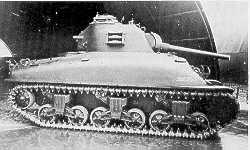 The 75mm gun, though an accurate weapon and excellent for HE, had no powers of penetration to deal with Tigers or head-on Panthers. It is true that the 17pdr was on a par with the German guns but they were strictly limited in numbers and were only carried in the thin-skinned Shermans and M10 SPs, upon which the enemy always concentrated his fire. Probably the long 75mm of the Panther was an even better armour piercing gun than the 88mm of the Tiger, but the Panther, unlike the Tiger, was vulnerable in the flanks and the rear. The 75mm in the German Mark IV was slightly better than our own 75mm but the Mark IV was inferior to the Sherman as a fighting machine and there was a reasonable chance in an engagement of obtaining the decision. Only the German Mark III, obsolete and rarely encountered, was definitely inferior to the Sherman in every respect. The 75mm gun, though an accurate weapon and excellent for HE, had no powers of penetration to deal with Tigers or head-on Panthers. It is true that the 17pdr was on a par with the German guns but they were strictly limited in numbers and were only carried in the thin-skinned Shermans and M10 SPs, upon which the enemy always concentrated his fire. Probably the long 75mm of the Panther was an even better armour piercing gun than the 88mm of the Tiger, but the Panther, unlike the Tiger, was vulnerable in the flanks and the rear. The 75mm in the German Mark IV was slightly better than our own 75mm but the Mark IV was inferior to the Sherman as a fighting machine and there was a reasonable chance in an engagement of obtaining the decision. Only the German Mark III, obsolete and rarely encountered, was definitely inferior to the Sherman in every respect.
 As a whole, in Normandy, the Allied armies had a vast numerical superiority in tanks and SPs over the enemy, but this superiority was difficult to exploit in the extremely close country of the BOCAGE, which lent itself admirably to the defensive tactics of the heavy German AFVs, by limiting the mobility of our larger and generally speedier AFVs. It was poor consolation to know that the Panther was vulnerable in flank and rear and the enemy SPs were vulnerable if located, when one was denied by the country in the powers of manoeuvre necessary to expose those thin flanks and rear in the one case and when one was only likely to locate the hidden SP by the expensive process of losing at least the first tank to come within its sights. As a whole, in Normandy, the Allied armies had a vast numerical superiority in tanks and SPs over the enemy, but this superiority was difficult to exploit in the extremely close country of the BOCAGE, which lent itself admirably to the defensive tactics of the heavy German AFVs, by limiting the mobility of our larger and generally speedier AFVs. It was poor consolation to know that the Panther was vulnerable in flank and rear and the enemy SPs were vulnerable if located, when one was denied by the country in the powers of manoeuvre necessary to expose those thin flanks and rear in the one case and when one was only likely to locate the hidden SP by the expensive process of losing at least the first tank to come within its sights.

During the late afternoon I had reports from ST PIERRE of heavy enemy fire from TILLY and it soon became apparent that the Germans were holding it strongly. Similarly, armoured recce which moved South from ST PIERRE came under heavy enemy fire.
I ordered 1 Dorsets, with 4/7th DG, to move up as soon as possible to Pt 103, to consolidate its capture - if necessary outflanking and leaving behind opposition in AUDRIEU and the villages South of it. In fact, the capture of AUDRIEU had been completed by 0845 hrs.
By the evening of the 9th, ST PIERRE was held, the 1 Dorsets and 4/7th DG had joined me at 103, where I placed the CO 1 Dorsets (with A Company, 5 Cheshires, less one platoon under command) in charge of the lay-out of the ground defences. We had had a heavy day fighting and had succeeded in stopping all further enemy movement Northwards and Eastwards. 4/7th DG, firing at enemy Panthers moving South down the SEULLES valley, had managed to knock out one at a range of upwards of 4,000 yards, with a lucky hit on the engine covers with HE.
Though the day had been a success, the SRY war diary rather plaintively records, "the days are very long". During the evening I issued orders for holding the ground we had won. The 8th DLI, with one squadron 24th Lancers in support, were ordered to hold ST PIERRE. The 24th Lancers less one squadron were ordered to hold the West and Southern part of 103, with 1 Dorsets holding the Southeast, East and Northeast, with 4/7th DG in support. The SRY I ordered to move back to the area BRECY so that they could re-form, re-fit and get some rest. It became apparent towards the evening that the enemy had moved back into LE HAUT D'AUDRIEU.
The night was passed rather uncomfortably with considerable enemy mortaring of the 103 position. 3Plt of 5th Cheshires had a particularly unpleasant encounter. An enemy patrol in two parties approached the Platoon's position at Pt 103 and when the first party was challenged its members threw up their hands in surrender. Rather unwisely, on seeing this, three privates went forward to bring in their prisoners when, without warning, the second enemy party opened fire, inflicting wounds from which all three men subsequently died. However, the Platoon's guns opened up on the patrol, killing three and wounding others, before the remainder surrendered - a total of two officers and twelve men.
10th June
I had hoped to be able to continue the advance southward to my next objective TESSEL - BRETTEVILLE feature but it soon became apparent that enemy opposition was stronger than I expected. On looking back at it now in view of the large enemy columns of both tanks and infantry which we had halted the day before it is not surprising that this opposition was strong.
In the early morning I got a report that the enemy were counter-attacking ST PIERRE and for a short time the 8th DLI were driven out but they counter-attacked at first light and we succeeded in reorganising and by re-attacking with the 24th Lancers, ST PIERRE except for the southern and western portions was recaptured and the 8th DLI re-established by 1130 hrs. during this time another enemy counter attack had come in from the direction of CRISTOT but this was driven off by 1 Dorsets and 4/7th DG.
During the morning I also got reports of bodies of enemy infantry moving in towards 103 from the West, i.e. From the area BUCEELS and STE BAZIRE. I dealt with this by ordering the SRY to move up from BRECY and by clearing the area South of the railway and up to the river NW of 103. SRY linked up with 24th Lancers in ST PIERRE, after having made contact with elements of 7th Armd Div who were driving South from BAYEUX to TILLY but were unable to get beyond BUCEELS.
By the afternoon all counter attacks had been driven off, with an estimated loss to the enemy of 2 Tigers, 4 Mark IVs and 3 75mm SP guns, and most of ST PIERRE was again in our hands. I realised however that the situation on Pt 103 was going to be rather uncomfortable and I was anxious to avoid if possible the heavy mortaring to which we had been subjected the night before. The only way in which it seemed possible to achieve this was to send out patrols to try and drive the enemy further away from us out of mortar range.
The 8th DLI were fully committed in ST PIERRE and the 1 Dorsets who had had very heavy fighting ever since landing were committed to holding the vital 103 feature. With all of my infantry committed I only had tanks available for patrols. I accordingly ordered SRY to send out squadron patrols in the East and Southeast direction and gave them the support of 147 Fd Regt. These patrols soon made contact with the enemy and succeeded in inflicting quite a lot of casualties as well as finding good targets for the artillery. I think they paid a handsome dividend.
That evening I ordered the SRY to relieve the 4/7th DG in support of 1 Dorsets and to relieve 24th Lancers on 103. I moved the 4/7th DG back to the area BRECY to rest and re-fit. I move the whole of 24th Lancers into ST PIERRE as the 8th DLI who had had heavy casualties needed strong support and I was anxious not to lose the village again.
After the fighting we had been through it was obviously necessary to bring up ammunition and petrol; food, of course, was also necessary. I had had assembled during the morning a column of some 60 lorries in the area of ST LEGER, ready to move forward whenever a favourable opportunity occurred. This column was moved forward in the early afternoon after the SRY had cleared up the area NW of 103. As it moved up under tank escort, it was subjected to some small arms fire from the AUDRIEU area into which the enemy had again infiltrated. There were no serious casualties however. Supplies were delivered and the column returned again under tank escort, taking back wounded amongst whom was my Brigade Major.
When the supply column arrived an American officer came with it in a jeep. He said he was a liaison officer from the American 155mm Regt and he asked if I would like any heavy artillery support. As can be imagined I was delighted to see him and gave him a number of targets which were out of range of my own 147 Fd Regt.
During the afternoon I also got an offer of support through the Commander 50th Div of fire from a battleship. I again indicated a number of targets and we were delighted to see some good shooting with 15" guns. This was directed by an air OP.
|