Memories of Mr Glynn Brown
THE WAR-TIME POEMS
OF
JOHN ERNEST BROWN.
#
John Ernest Brown.
12/10/1910 - 5/3/1964
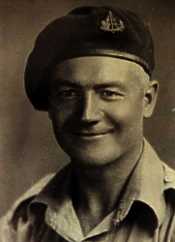
My father John Ernest Brown was the second child of Leon Ernest and Lucy Brown, and was born on the 12th October 1910 at Hastings Sussex.
After he left school he went to work for the largest photographers shop in Hastings known as Gifford Boyd's; we do not know how long he worked there, but photography was his hobby for the rest of his life.
For some reason, perhaps because of the depression, he joined the Army enlisting in the Royal Sussex Regiment at Eastbourne, Sussex on the 26th January 1931 for a period of seven years. His army number is 6397247 and his trade when he enlisted was given as Grocer's Assistant.
Within a year (23rd January 1932) he was in India and spent almost four years there, then on to Egypt (27th October 1935) followed by a stay in Sudan (18th March 1936 to 28th December 1936). We know from letters that he sent to his mother, (these being still in the family), that he was almost following in his father's footsteps when he was in the Army.
During his time in the army he improved his education and in 1931 passed a Third Class Army Certificate of Education and in 1933 passed a Second Class Army Certificate of Education in the subjects of English, Mathematics, Map Reading and Army & Empire.
He also managed to complete a Vocational Training programe in Painting and Decorating.
The last two years of his service was spent as a military policeman before he was transferred to the Army Reserve 25th January 1938.
This was short lived as on the 15th June 1939 he was recalled to service and after the Second World War broke out was part of the British Expeditionary Force, eventually being evacuated from the beaches of Dunkirk.
He was then transferred to the 44th Reconnaissance Battalion, Royal Armoured Corps. Part of Monty's 8th Army, on the 22nd January 1941. He was sent to the Middle East as a photographic developer; all we know about this period is that the unit would drive off into the desert in vehicles for some days before returning to base camp.
The majority of his war time poems were in an exercise book with a few loose ones on various pieces of paper. Some of the writing is badly faded and a few words were missing where the paper has crumbled away.
I have used my imagination where words are unreadable or missing and have tried to keep them in the order that he wrote them.
A Trip to the Middle East
(Via South Africa).
I quite remember that fine day, way back in forty-two,
It was the 31st of May; we said farewell (Adieu).
For we were on a Yankee ship all leaning on the rails.
And wondered when we'd start our trip we had heard all different tales.
At last! We heard the rumble, of anchor lifted high
And also heard the silent throb as engines took their stride.
Then slowly we began to move, our eyes looked more and more
The sight we did not want to lose of Dear Old England's shore.
Soon the land began to fade and soon we saw no more
Of our dear homes so far away the land which we adore.
After several days afloat, we saw nothing of our coming boats,
Until one day the cry arose, There's land ahead! Where? No one knows.
But far ahead I saw with a frown a native country and a town.
The hills arose in misty heat for us it really was a treat.
As the day got brighter and the shore was near,
Black boys in their lighters passed which gave a cheer.
Tree Town in its glory, sweltering in the sun
Natives in their dinghies caused a lot of fun.
Several chaps among us, for this was their first trip,
To a native country, on this Yankee ship.
Camels passed the quayside, as on their way they trekked.
And the bells rang softly, hanging from their necks.
Just a week we stayed at bay with the anchors fast,
Then once again we're on our way; Tree Town left at last.
J.E.Brown.
|
Lost in a Jeep.
Here is a story, so please do not weep
Of two soldier lads, who got lost in a jeep.
One afternoon on a hot summers day
They were driving along, so happy and gay.
They drove on for miles, in desert so bare,
Old Lennie was learning, so he never cared.
Now when they had finished driving around,
They thought, they had better go back.
But to their dismay, as they looked over the ground
They couldn't pick out the right track.
And as they drove on with all haste,
And looked across the sandy waste.
They strained their eyes with all their might,
At last! They saw the old campsite.
But when they reached the blinking spot,
Where the Recce they had been,
It seemed that they had moved a lot,
For nowhere! Could they be seen.
Now when we asked some other lads,
If Recce, they had seen,
They gave a laugh, these rotten cads
And said, "no no old bean".
Now as the sun was sinking fast,
So quickly in the west,
We thought that soon, we would not last,
And very soon we'd rest.
But as the time was slipping by,
We'd knew we'd have another try,
For we had no where to sleep,
Only beside, our faithful jeep.
So as we rolled on through the night,
We heard a voice cry out, "hold tight!".
And wondered who that could be,
As we looked up we could see,
A man from good old Recce.
So at last our journey ended
And the Officer put us right.
"In the morning you're be mended
So you've better stay the night".
When we had something to eat,
There we lay just by our jeep.
Then we closed our eyes quite tight
And we slept right through the night.
J. E. Brown. |
| Old Lennie, was in fact a young soldier, Leonard William Masters, 14248613, who was to become a corporal in the 328 Workshops Company, Royal Engineers. He was also a native of Hastings, Sussex, the same as my father, so it's no wonder that they got on well together. Lennie Masters was killed on Sunday, 8th July 1945, age 23. |
LIFE.
Life, is what we make it,
Life, can be good or bad,
It's up to you to make it,
And not feel quite so sad.
Now when you wake up in the morn.
With the sound perhaps of a motor horn,
Or may be that your alarm is ringing,
Or the birds outside are gaily singing.
Don't jump out of bed and say,
Here's another day, "Oh how rotten",
Just stand for a moment and pray,
For days just like dreams are forgotten.
And may we hope that very soon,
This war will end and like a great big boon,
And back into our loved ones arms,
The peace of life so full of charms.
J. E. Brown. |
Terry. (Born December 1942).
On the 21st day of December,
Is one of the days to remember,
For at five forty pm in the evening,
Our Terry was born, how so pleasing.
Oh! What a joy to see Terry,
Oh! What a joy it's to be,
For we are happy and merry
To hold him on our knee.
And we don't mind if he cries aloud,
For we both feel, so very proud.
And from our hearts so meek and mild,
We thank God for a lovely child.
J. E. Brown. |
What! A Mess?
Here is a story and it's true?
Of Sgt. Hessey and his crew,
Take first the Sgt. he's not bad,
Although his work soon drives him mad.
Then there comes old Perrin,
He is our jolly cook,
And if we say, the food's bad;
We don't half, get a look.
Now we come to Private Jones,
Who takes the meat off all the bones,
His hand goes in the sack of mud,
And swears all day, and peels the spuds.
Private Irons is the chief waiter,
Serves the roast and then the tater.
Then he sits into a chair,
And polish shoes, all day with care.
Private Greenfield is a nut,
Works all day and says "tut, tut".
When he eats his head keeps nodding
Looking up to see the robin.
Then we come to Loveland,
He thinks he's in a band,
He taps all day for he must play,
With drumsticks in his hand.
Then there comes our Hobson,
Great big lout is he,
Stoking all the fires up
"Jobs good enough", says he.
Then comes Private Dougherty,
He's our kitchen boy you see,
Mixed up with the pots and pans,
Scrubs the floor to wash his hands.
Private Orton moves with care,
All the cups and saucers there.
Pots there all along the side,
To be washed and washed and dried.
How about old Draycott,
Knows to serve a whiskey tot,
Then with care he takes it in ,
Has to come back for a gin.
Private Elliott is a wow,
For all the lies he tales,
I'm going for my washing now,
Down in Tunbridge Wells.
Although he takes a week or more,
And not going for a mike,
I'll be back, quite by four,
If I take old Brownies bike.
Have you seen our Malster now,
Waiting there to think,
As he spills the soup "Oh Boy"?
Until his face go pink.
Now we come to the last,
His name is Private Brown,
His hairs gone white from writing this,
And foreheads in a frown.
J. E. Brown. |
The Human Zoo.
Have you seen our human zoo,
If not, come just one or two,
For your see what I have seen,
Humans eating fat and lean.
You may say, "what's in a name",
We eat, just the very same,
Ah! But sir, this is the Mess,
Where our dear Officers eat and rest.
The first course, it is the soup,
They swallow it down and nearly choke,
Then someone shouts with a hiss,
Hey, waiter! bring in, the damn fish.
Then the meat course and the veg;
Eating now to fill the wedge,
Then the C.O. up he shouts,
"Bring more of these blasted sprouts".
Eating all the faster now,
Eating all in vain.
For tomorrow, they'll be in bed
With a tummy pain.
After eating all the meat,
Hurry now and get the sweet
Then if you have got the time
Rush me in a gin and lime.
What! No savoury tonight,
Goodness man, that's not right,
For my trousers belt I'll ease
Bring me in some bread and cheese.
Then they all sit smoking there,
Eating biscuits just with care;
Now they're off to get some beer
Not enough to eat in here.
J. E. Brown. |
The Matchstick and the Private.
A matchstick, lay on the Barrack Square,
Inspection was on, and the General there,
The General, saw it, with first look
The R.S.M. put it down in his book.
The General, shouted to the C.O. "What a shame
Find that man, and take his name".
The C.O. said to the Major with care,
"Find out who put that rubbish there".
The Major, saw the Adjutant grin,
And said, "My man that is a sin,
This is no laughing joke you see,
So you, can find that man for me".
The Adjutant looked around him, then
He saw the crown of the R.S.M.
To him he cried with a loud voice,
"Find that man, you have no choice".
The R.S.M. saw the Captain of Company 'B'
And said, "you know that man better than me,
You've better find him and bring him up",
The Captain replied and said "tut, tut".
The Captain saw his first Lieutenant
And was he worked up in a rage
"Find this man you blasted remnant
Before I put you in the cage".
The Lieutenant said to the C.S.M. "run,
Go and find that blasted little scum,
Find me who put the rubbish there
And bring him up before the chair".
The C.S.M. to his mess he ran,
I'm not going to take the can,
"Come here Sgt. You can look,
And find this man, the blinking crook".
The Sgt. With a mad rush,
Found a Cpl; and swore and cussed,
"This blasted man who made the affray
You must find him and don't delay".
So at last this Cpl. found his man,
"Come here you rat, and take the can",
And so next morning, on the mat,
10 days C.B. for just one match.
J. E. Brown. |
Leaving the Middle East.
I won't mind a bit at least,
When I leave the "Middle East",
When my boat sails from this shore,
I won't see it any more.
What, a lovely feeling,
And what a lovely sight,
It won't seem believing,
But it will, be right.
Leaving all the wogs behind,
And the scorching sun,
What, a pleasant thought of mind,
That our duties done.
Sailing up the Med, so blue,
I shall, understand,
That at last, my dream's come true,
Sailing to "Our Land".
J. E. Brown. |
Night Duty.
Standing on the cliffs one morn.
I was facing out to sea,
The sun rose bright, out of the dawn,
It was a glorious sight to see.
My duty was to watch that sea,
The night it seemed so long,
But really it had to be,
As this rotten war was on.
We had to stand to guard our shore,
Our dear old Motherland,
To keep our dear old England
Safe from the enemies hands.
And as I stood there thinking,
I was wondering, if in France,
Our enemy stood there waiting,
Waiting for their chance.
And then I heard a sudden roar,
From way up in the sky,
I looked up, and there I saw
A group of bombers, fly very high.
And through my glasses I could see
As out to sea they flew
The colours of the R.A.F.
The Red, and White, and Blue.
I knew that we were not alone,
To watch this dear old shore,
We knew the Navy still stood prone,
To bring our food for sure.
And so my duty finished for one night,
I'll say and hope, that I'll be right,
As sure as the rising of the sun,
Invasion to our shores will never come.
J. E. Brown. |
|